I
Foundations
The three threats you're actually preparing for, the 21 Readiness Principles that structure the entire plan, what you already have, and what to buy with your first fifty dollars. Read straight through.
How to keep your home warm, your water safe, and your pantry full through the weeks the power, the stores, or the supply chain fail you.

359 pages · 21 Readiness Principles · 40 directory entries · 4 hour-by-hour emergency protocols.
Instant AccessPDF + EPUB, right after checkout
Secure CheckoutEncrypted, handled by Stripe
7-Day GuaranteeFull refund, no questions
359 Pages21 Readiness Principles
You've seen them happen. Texas 2021. The COVID shortages. The winter storm that knocked out half the county for a week. These aren't hypothetical scenarios — they're events that have already put people in the emergency room because they weren't ready.
No heat, no light, no refrigeration — and the food clock starts counting down the moment the grid fails.
Safe indoor heating methods, the fridge-to-cooler timeline, and lighting that doesn't need a single outlet. Pages 107, 164, 189.
Empty shelves, delivery delays, and the pantry that looked full last week now runs out in three days.
The two-week pantry built from what you already eat, the rotation system that keeps it fresh, and the no-cook backup. Pages 136, 155.
The tap stops, the toilet won't flush, and you've got maybe twelve hours of drinkable water left in the house.
How to pull forty gallons from your water heater, the three safe treatment methods, and the one-gallon-per-day budget. Pages 61, 70, 80.
The compound emergency: no power, no water, no restocking. This is where most plans collapse.
The 72-hour timeline with hour-by-hour priorities and the neighbor network you build before you need it. Page 332.
This is not a survival manual. It's a reference book with a reading entry. You'll read the first sixty pages to understand the model, then use the rest by situation.
The three threats you're actually preparing for, the 21 Readiness Principles that structure the entire plan, what you already have, and what to buy with your first fifty dollars. Read straight through.
Water, heat, and food. How much you need, where to get it when the primary source fails, how to store it, treat it, or cook it without power. Twelve chapters, each solving one specific problem.
Forty entries, alphabetized. Every item you'll use, from batteries to water filters to emergency toilets. What it does, what it costs, how to store it. No brand names, no affiliate links.
Medications and medical supplies. Pets. Limited mobility. Renters and apartment dwellers. Caring for someone in another home. When you have to leave. Six chapters for the circumstances that break the standard plan.
Hour-by-hour checklists for the first 72 hours without power, the first week without restocking, the first five days without water, and the compound emergency. The part you keep accessible.
The full list of 21 Readiness Principles, the quick materials table, the 14-day shopping list by priority, water treatment methods at a glance, safe temperature ranges, and the neighbor contact card.
Large type, wide margins, and no wasted space. Formatted so you can read it without glasses and find what you need without flipping back and forth.
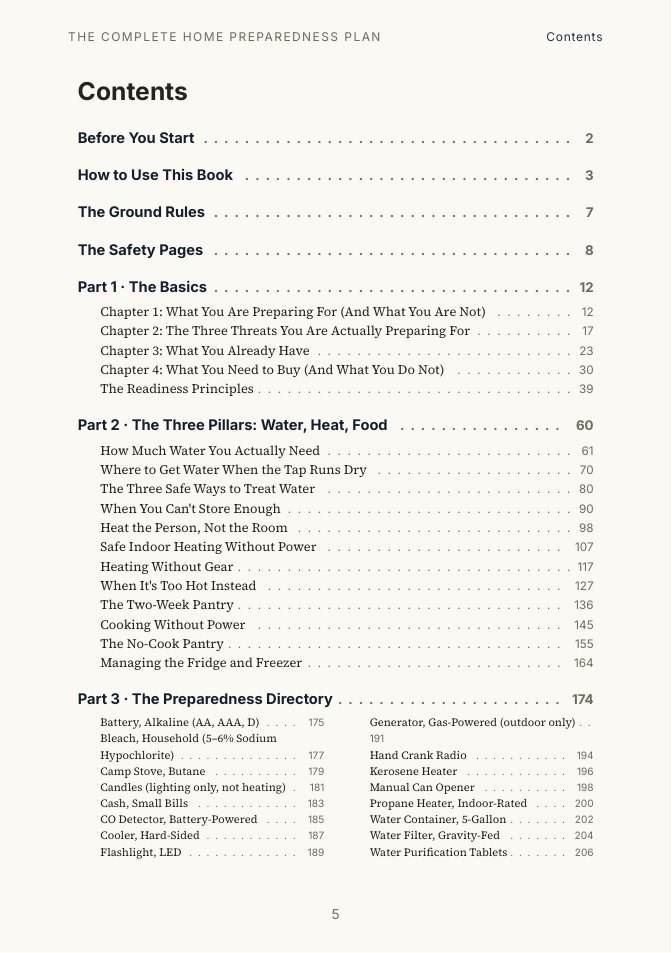
The table of contents. Every chapter and protocol listed with page numbers. The structure is visible from the start.
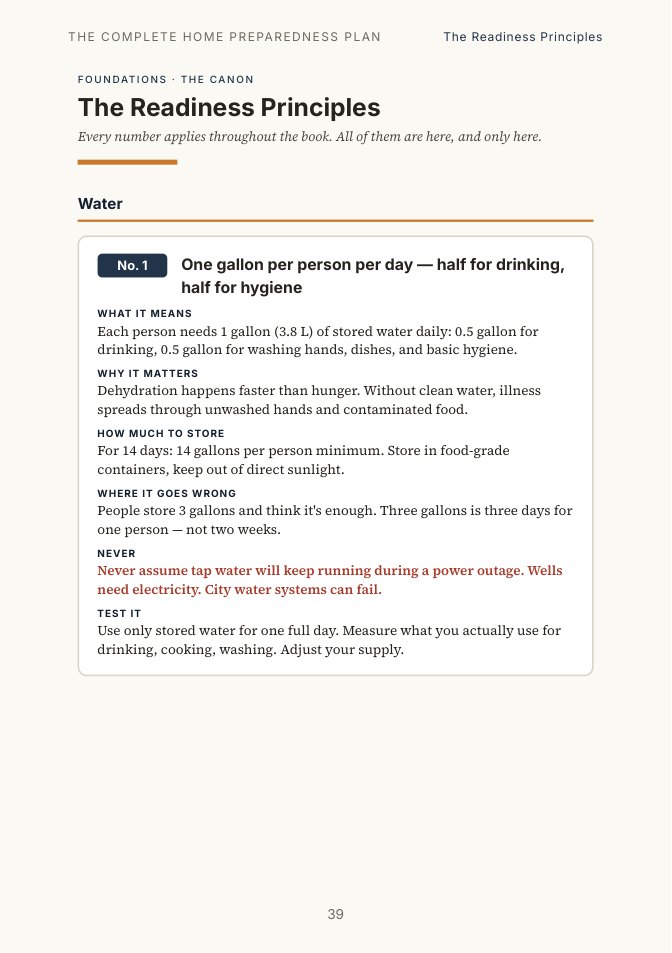
The Readiness Principles chapter. The twenty-one core principles that organize the entire plan, each explained in plain language.
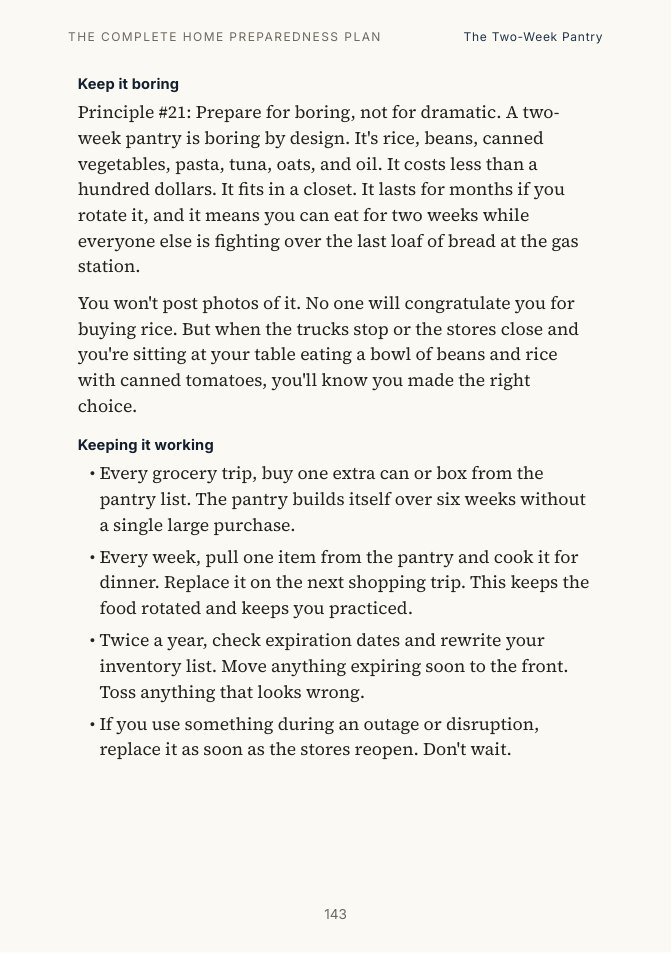
A typical chapter page. Step-by-step instructions, short paragraphs, safety warnings in boxes. Everything you need is on the page.
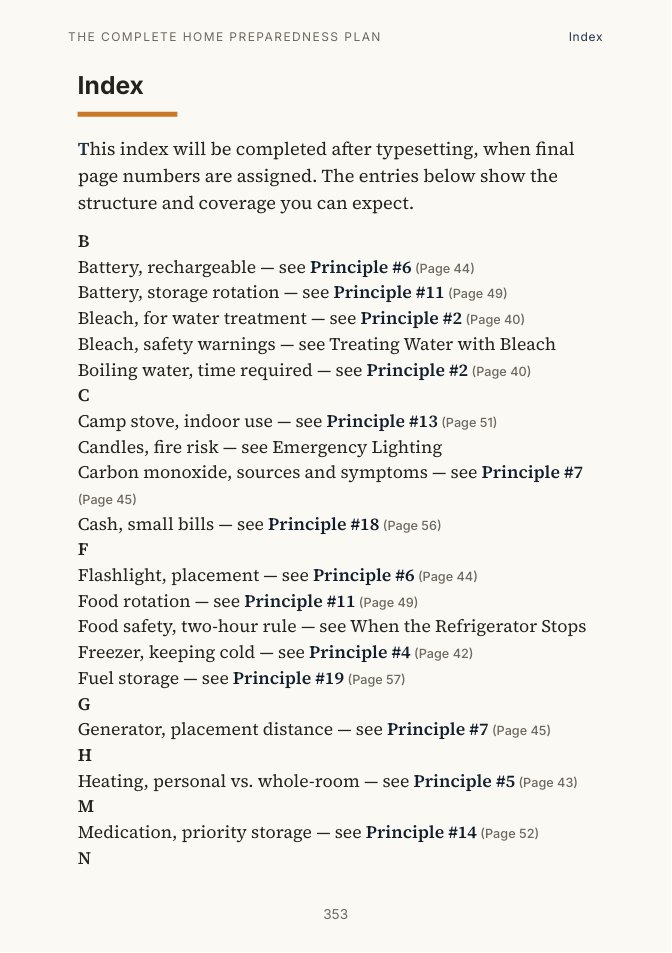
The appendix and index. Quick reference tables, shopping lists, and the full index. Built to be used during an emergency, not just before one.
If this book doesn't give you a clear, usable plan within the first week, I'll refund your purchase. The files stay with you. If it's not worth keeping, you shouldn't have paid for it.
Introductory price. When the second edition publishes with expanded protocols, the price rises to $59.99 — everyone who buys now keeps free access to it.
Get the book →
"I will not sell you gear you don't need. I will not invent statistics or miracles. I will tell you what works, what doesn't, and when you need to stop and call for help."
For twenty-two years I trained people for situations exactly like these. Not doomsday scenarios — just the predictable emergencies that happen when infrastructure fails for a few days or a few weeks. The plan worked because it assumed ordinary homes, ordinary budgets, and people who had other things to do besides prepare.
For twenty years after that, I made sure my own household was never caught off guard. I watched COVID empty the shelves and Texas 2021 knock out the grid, and I watched people I knew end up in bad situations because they'd meant to get ready and hadn't.
I'm not selling gear, I'm not running a subscription, and I don't benefit if you panic. I wrote this because the information should exist in one place, in plain language, organized so you can actually use it when the power fails at two in the morning.
Hour-by-hour checklists with fixed priorities — not general advice. What to do in the first hour, the first four hours, the first twelve, and every twelve after that.
What to do in the first hour, the first four hours, the first twelve, and every twelve hours after that. When to secure the freezer, when to fill the tub, when to stop opening the fridge, and when to assume three days.
How to count meals instead of cans, when to start the two-meal day, how to locate public distribution points, and when to decide whether to go early or extend at home.
How to capture what's left in the pipes, drain the water heater, ration one gallon per person per day, and decide when your supply crosses the threshold that requires outside help.
The priority matrix when water, heat, and food all compete for your attention. The 72-hour timeline with decision points, so you don't forget a step when everything fails at once.
No subscription, no special app, and nothing extra to buy.
No. There's an entire chapter for renters and apartment dwellers (page 281), and every protocol accounts for limited space and shared walls. The plan assumes you don't have a basement, a garage, or a backyard.
No. The first-priority shopping list is under fifty dollars. The book covers generators (page 191), but they're listed as optional with clear warnings about what they can't do and when they're not safe.
There's a full chapter on limited mobility and accessibility (page 272). It addresses light placement, water containers you can actually lift, food you can prepare without strength or standing, and how to arrange help before you need it.
There's a chapter for that (page 289). It covers what needs to be stocked at their location, the medication and contact lists that have to live in both homes, and the contingency plan for when you can't get there.
The free information is scattered, often conflicting, and almost never includes hour-by-hour protocols or decision matrices for when resources compete. This book cross-references every chapter and gives you the exact page number for every method.
You can print it. The PDF is formatted for printing, and the protocols are designed to be filed or posted where you'll see them. Many buyers print the four emergency protocols and the shopping list and leave the rest digital.
You'll get the updated files automatically. No repurchasing, no expiration. When water treatment guidelines change or new protocols get added, you'll receive the revised edition.
Read Part One (Foundations) straight through — it's sixty pages and explains the model. After that, use the book by situation. The table of contents, the index, and the cross-references take you where you need to go.
The plan for the week the power is out, the stores are empty, or the delivery trucks stop coming.
Get the book →Gary: I kept meeting people who knew they should prepare and hadn't. They didn't need motivation — they needed a plan that assumed an ordinary home, an ordinary budget, and a person who couldn't lift fifty-pound water jugs. This is that plan. If you've been meaning to get ready, now you have exactly what you need to start.